
Emerging Tech in Anticipatory Action: A Demand-Side Ecosystem Analysis of Mercy Corps Ventures' Anticipatory Action Accelerator

Photo credit: Ezra Millstein / Mercy Corps
We are pleased to share the release of Emerging Tech in Anticipatory Action: A Demand-Side Ecosystem Analysis of Mercy Corps Ventures' Anticipatory Action Accelerator — a new report from Mercy Corps Ventures (MCV) and the SPARC Knowledge research consortium — a collaboration between Mercy Corps, Cowater, ODI Global, and the International Livestock Research Institute (ILRI).
The Anticipatory Action Accelerator is an initiative launched in 2025 by the Humanitarian Venture Lab at Mercy Corps Ventures, announcing a call for proposals from teams of applicants consisting of tech companies and startups working in emerging markets and local and international humanitarian actors with ongoing anticipatory action programs in settings highly exposed to climate hazards.
As climate-related crises intensify, the humanitarian sector has been shifting from reactive response toward Anticipatory Action (AA) — a proactive approach that acts before disasters strike through science-based forecasts, pre-defined triggers, and pre-arranged financing. Research has shown that AA can be up to seven times more cost-efficient than traditional response (FAO, 2023). Yet despite this promise, the nascent AA innovation ecosystem remains conceptually fragmented and operationally inconsistent.
This report maps how the AA innovation ecosystem functions, identifies the system barriers that inhibit innovation, and assesses the potential of programs like the Anticipatory Action Accelerator (AAA) to shape a more mature and coherent field through the introduction of emerging technologies to automate processes such as forecasting, trigger activation and digital payments. The study combines a comprehensive quantitative analysis of all 232 applications received by the AAA from 57 countries with 10 in-depth, semi-structured interviews with AAA applicants, review panel judges, and leading AA and humanitarian innovation experts. Ultimately, the AAA offers a demand-side window into what innovators are building, where, and why.
Insights from the AA Accelerator
Geographic Distribution
The AAA successfully surfaced a rich and diverse pipeline of AA innovations from across the globe, but the data also exposed significant structural imbalances in the ecosystem that the program both reflects and has the power to help address.
The geographic distribution of applications is heavily skewed toward Eastern Africa, which alone accounted for 40% of all eligible proposals (n=164). Kenya (18%), Nigeria (9%), and Uganda (9%) combined represent over one-third of all submissions. A total of 33 countries appear only once. Africa as a continent captures 58% of proposals; Asia holds around 23%, the Americas 16%, and Oceania less than 1%.
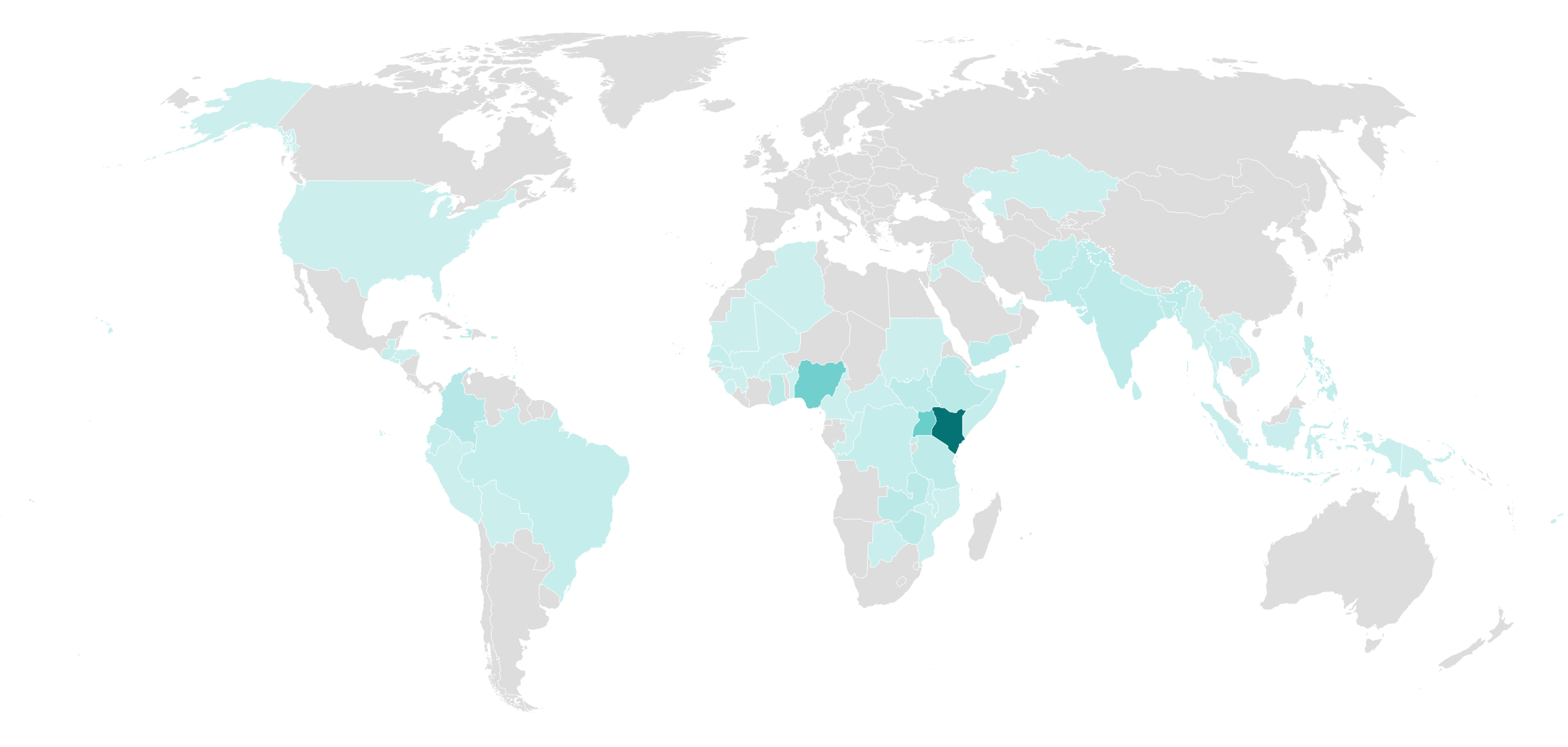
This concentration is not simply a reflection of where climate risk is highest. It is also potentially shaped by Mercy Corps’ institutional presence in the region and by the English-only application materials — a design choice that revealed some limitations, particularly for non-English speaking applicants.
Hazard Focus
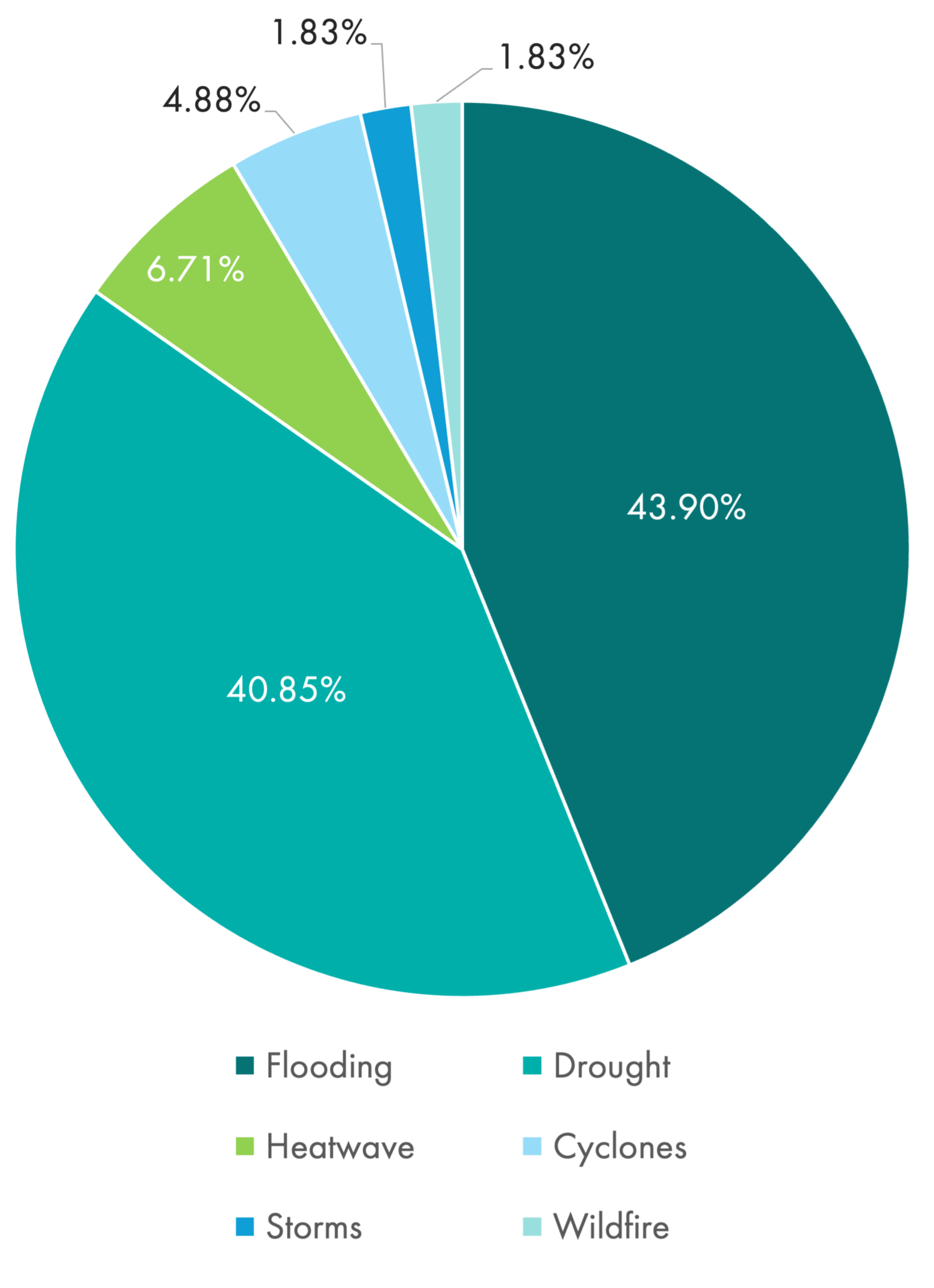
Flooding (44%) and drought (41%) together account for 85% of all proposals. The remaining 15% are spread across heatwaves, cyclones, storms, and wildfires. This pattern holds across all major regions: in Africa, 92% of proposals address flooding or drought; in the Americas, 82%; in Asia, 70%. While these hazards are genuinely among the most frequent and forecastable, the near-total absence of solutions for cyclones, conflicts, or pandemics reflects a blind spot in the ecosystem's risk coverage.
Target Users
The primary beneficiaries of proposed solutions are smallholder farmers (34%) and low-income populations (32%), together representing two-thirds of all applications. Women (7%), youth (5%), and persons with disabilities (2%) are rarely the primary focus — a pattern that reflects broader equity gaps in the humanitarian innovation space. While these groups often overlap with the primary categories, the data points to a systematic underrepresentation of the most marginalized sub-groups as explicit design targets.
Technology Use
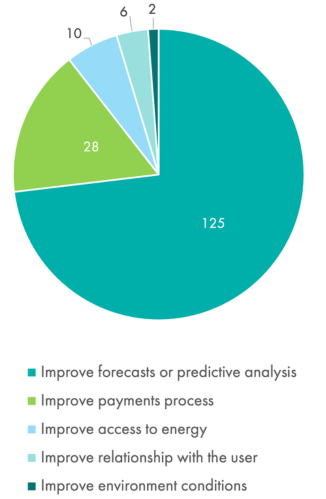
Artificial intelligence and machine learning (AI/ML) feature as a core technology in 96% of proposals — a striking concentration that shapes the entire character of this cohort. Of all technology applications, 93% aim to improve forecasting or predictive analysis. Only a small minority focus on improving payment systems (28 proposals), user engagement (10), energy access (6), or environmental conditions (2).
Solutions Maturity
Most solutions in the pipeline are early-stage: 38% are at the technology concept stage, and only 24% are validated or fully launched. Nearly 45% report zero active external users — a figure that highlights both the pipeline's potential and its distance from operational deployment. Notably, 29% of proposals showed inconsistencies between their self-reported maturity stage and the number of active users claimed, suggesting that applicants may have incentives to overstate their readiness.
Needs Beyond Funding
Interviews with AAA applicants revealed that the value of the Accelerator extends well beyond grant funding. Participants highlighted strong demand for technical support, visibility and legitimacy, mentorship, data access, and structured matchmaking with humanitarian implementers. Many noted that connecting with other organisations tackling similar challenges was among the most valuable and underserved aspects of the program.

Photo credit: N Shrestha / Mercy Corps
State of the Ecosystem: Nine Key Findings
Across the quantitative and qualitative analysis, the study identified nine structural features that define the current state of the AA innovation ecosystem:
The ecosystem is structurally constrained by a 'circle of usual suspects' — a small group of large humanitarian organizations dominates standard-setting and agenda-setting, while smaller actors, governments, and communities occupy marginal positions.
The technology portfolio is narrow and concentrated on AI/ML forecasting, crowding out potentially critical innovations in financial systems, last-mile delivery, and community communication.
High cost, knowledge, and data barriers limit participation, particularly for smaller and local actors who often lack the infrastructure to implement sophisticated technologies effectively.
Financial resources are fragmented and misaligned with validation needs — short project cycles prevent iterative testing and mean that promising solutions are frequently abandoned when funding windows close.
Innovation remains 'projectized', operating through isolated pilots rather than integrated national systems, which produces duplication, weak sustainability, and slow institutionalization.
End-users and communities are largely absent from co-design processes, undermining contextual fit, trust, and long-term sustainability.
Actor roles and relationships are asymmetrically distributed and fragmented, with ad hoc partnerships that rarely survive beyond individual grant cycles.
Conceptual ambiguity persists around what constitutes Anticipatory Action, and short-term funding rules reward low-risk, incremental progress over transformative approaches.
The evidence base is weak and knowledge exchange is limited, leaving a poor foundation for scaling, replication, or learning across the field.
Ecosystem and Accelerator Insights
The central problem is not a lack of tools, but the absence of a shared conceptual foundation. A harmonised definition of AA, anchored on three non-negotiable elements (scientifically defined triggers, pre-arranged financing, and pre-planned interventions), is the starting point for everything else. Without it, funding frameworks remain inconsistent and evaluation at scale is impossible. Compounding this, many humanitarian actors lack the technical capacity to implement sophisticated technologies, financial cycles are too short for multi-season testing, and AI/ML dominance risks crowding out equally critical work in cash delivery and last-mile communication.
Within this context, the Accelerator's role is two-fold: it functions as a broker — connecting siloed actors and providing structured pathways for partnerships that outlast grant cycles — and as a standard-setting device, clarifying what counts as AA and aligning the field around its core principles. Both functions are most valuable precisely because they address the ecosystem's deepest failures: fragmentation and definitional ambiguity.
Recommendations: Building a More Coherent Ecosystem
The report closes with four interconnected recommendations representing a coherent strategy for moving from a fragmented field to a maturing system.
The first focuses on broadening accessibility and inclusion — translating materials into major working languages, disseminating calls through regional and local networks, and building evaluation criteria that specifically benefit solutions targeting the most marginalised groups.
The second calls for diversifying innovation scope and support, including extending funding cycles to a minimum of 18–24 months, creating dedicated tracks for underrepresented areas (last-mile communication, non-AI/ML technologies, hazards beyond floods and droughts), and calibrating support to solution maturity. Mentorship and technical assistance must become structural features, not afterthoughts.
The third recommends reinforcing the Accelerator's brokering function by formalising partnership mechanisms across the Quadruple Helix, making government participation mandatory, and requiring end-user communities to be involved in co-design as a non-negotiable condition of funding.
The fourth addresses the need to institutionalise learning and evidence generation — developing a systematic MEL architecture, allocating dedicated evaluation resources, and housing knowledge in an accessible multilingual platform that feeds directly into MCV's policy and advocacy work, positioning the Accelerator as a system intelligence node for the entire field.

Viñé, L., S. Hart, and M. Bulanda. (2025) Emerging Tech in Anticipatory Action: A demand-side ecosystem analysis of Mercy Corps Ventures' Anticipatory Action Accelerator. Technical Report. London: SPARC.