
Pilot Insights | Scaling Up Anticipatory Cash Transfers pilot for pastoralists in Kenya

Photo credit: Ezra Millstein / Mercy Corps
In September 2023, Mercy Corps Ventures partnered with Fortune Credit, Shamba Network, and DIVA Technologies to pilot blockchain-powered smart contracts for delivering anticipatory cash transfers to pastoralist communities in Kenya. That pilot demonstrated a 75% reduction in transfer costs and 90% decrease in settlement time compared to traditional methods.
Building on these promising results, Mercy Corps Ventures collaborated with Ripple, Fortune Credit, and DIVA Donate in April 2025 to expand the program and test a new payout structure, utilizing Ripple's stablecoin RLUSD on Ethereum. The core objective of this scale-up campaign remained unchanged: providing timely, need-based cash support to pastoralist households whose livelihoods depend on healthy pasture availability. Over 50 million people across sub-Saharan Africa practice pastoralism, a way of life increasingly threatened by changing weather patterns.
In this scale-up campaign, we shifted from a single end-of-season assessment to a multi-checkpoint design. The rainy period was divided into nine checkpoints spaced every 10 days (10 October–31 December 2025), with smart contracts assessing NDVI vegetation data against a fixed threshold at each interval and triggering payouts when conditions fell below it, resulting in four triggered payouts that delivered support earlier and more frequently as climate stress emerged.
Insights in Brief
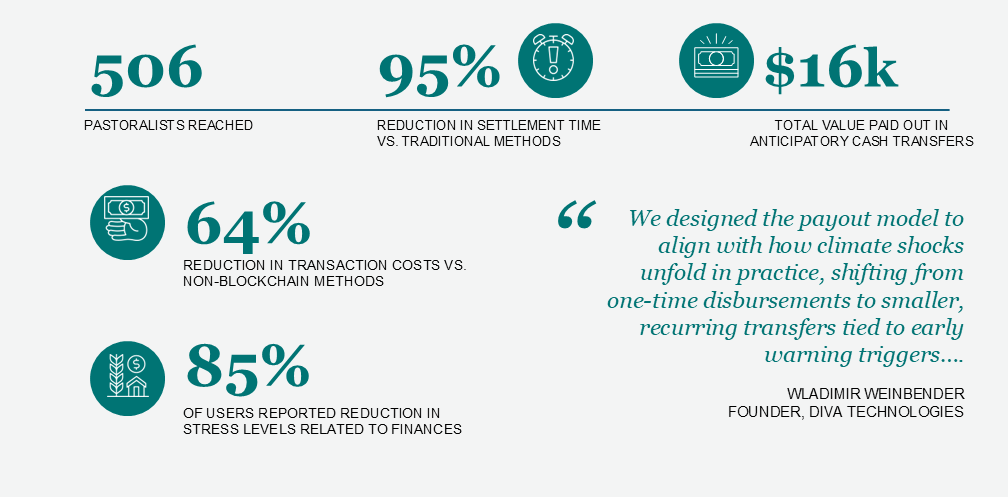
Blockchain-based payouts cut settlement times by 95%+ from 7–10 days to under 6 hours, a +5pp gain over the initial pilot driven by iterative operational refinements. Smart contract automation delivered funds directly to pastoralists without manual processing or intermediary delays.
Shifting from a single payout to a multi-window model (9 checkpoints, 4 triggered payouts) enabled earlier, more frequent support. The share reporting improved ability to meet unexpected expenses rose from 53% to 64% (+11pp), financial stress reduction climbed from 77% to 85% (+8pp), and participant trust remained high with an NPS of 82.
Households receiving payouts reported significantly stronger financial resilience. Three-meals-per-day consumption jumped from 13% to 77%, while 64% reported improved capacity to handle unexpected expenses, indicating that faster, more frequent disbursements translated directly into material welfare gains.

This report is the second in a two-part series. The first blog outlined outlined the scale-up launch, learning questions, and the hypotheses we set out to test. This final report will share findings from the concluding phase of the scale up. Written by Njeri Muhia, Pilot Manager, Mercy Corps Ventures.